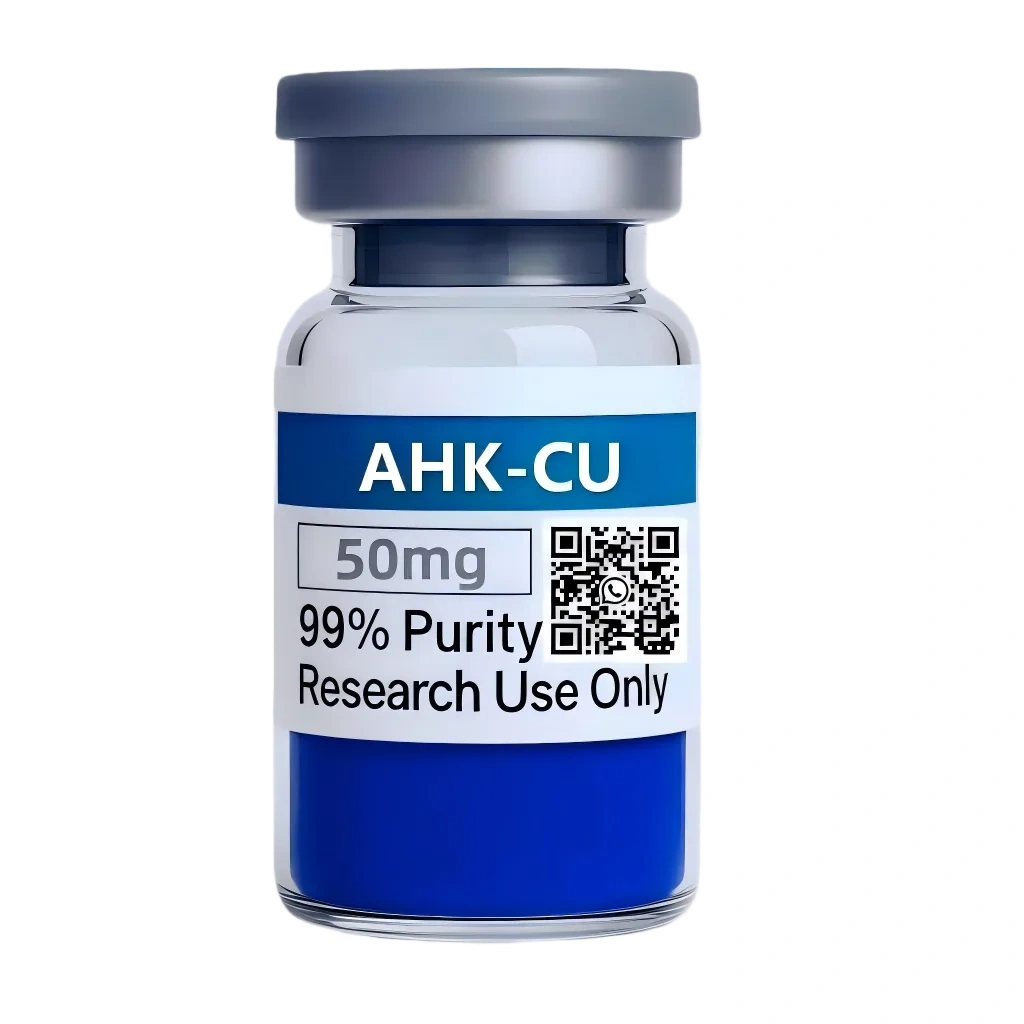
Copper-chelating tripeptide analog. Investigated in dermatological research for effects on follicular biology, extracellular matrix remodeling, and collagen biosynthesis.
AHK-Cu is a research compound available through our china peptide catalog as a finished, lyophilized vial from an established Chinese manufacturer. It belongs to the Copper-peptide complex (tripeptide)
Research Areas
Skin biology, fibroblast research, wound healing, copper-dependent enzyme biology, extracellular matrix
Available Variants
| Name | Strength | Pack Size | Purity | Availability |
|---|---|---|---|---|
| AHK-Cu | 100 mg | 10 vials | ≥98% | In Stock |
Specification Highlights
Quality & Testing
Testing method: HPLC / LC-MS . Products are supplied against the specification shown on the applicable product page. The standard catalog purity specification is ≥98% unless otherwise stated. Product-specific specifications and quality-control information may vary by compound and batch. Every batch is tested by the manufacturer for purity and concentration as part of routine quality control, using methods such as HPLC and LC-MS. These results are kept in the manufacturer’s internal quality-control records and are not issued as a separate certificate or document.
Variant Notes
Copper complex of the tripeptide alanyl-histidyl-lysine. Investigated in cellular models of skin, hair follicles, and the extracellular matrix, including processes related to fibroblast activity and collagen metabolism.
Research Areas
Copper-Peptide Biology Research AHK-Cu is studied as a structural variant of GHK-Cu in copper-peptide pharmacology research. The His residue provides a high-affinity coordination site for Cu²⁺, forming the stable 3N coordination complex (imidazole N, N-terminal amine, backbone amide nitrogen) characteristic of copper-tripeptide complexes. Research has compared AHK-Cu with GHK-Cu in terms of copper-binding affinity (Kd), copper delivery efficiency to cellular cuproenzymes, and receptor-mediated activity in fibroblast models. Extracellular Matrix and Collagen Research Copper-dependent lysyl oxidase (LOX) is required for collagen and elastin crosslinking — a fundamental ECM maturation process. Research has examined whether AHK-Cu can serve as a copper donor for LOX activity in fibroblast culture models, improving ECM organization markers. Studies of TGF-β1 expression, collagen synthesis rates, and MMP/TIMP balance in AHK-Cu-treated fibroblast cultures contribute to understanding of copper-peptide effects on connective tissue biology. Angiogenesis and Wound Healing Models Copper is an essential cofactor for angiogenesis — endothelial migration and tube formation require copper-dependent enzyme activity, and copper chelation suppresses angiogenic responses in vitro. Research has examined AHK-Cu’s ability to promote endothelial cell migration, tube formation in Matrigel assays, and VEGF expression in wound healing model systems, as part of broader copper-peptide angiogenesis research. ## Sourcing AHK-Cu From China
AHK-Cu is available through our platform as a china peptide sourced directly from an established Chinese manufacturer. Three points define how we handle it:
- Factory-direct, not trader-sourced. We confirm availability and specification with the manufacturer before the order is confirmed. There is no intermediary resale of unknown-origin vials in this catalog.
- Specification before shipment. The purity and concentration specification shown on this page is the manufacturer’s batch specification. Product-specific quality-control information travels with the order.
- Research-use discipline. Like every listing in our catalog, AHK-Cu is supplied for laboratory research use only, under strict research-use terms.
For buyers comparing chinese peptides suppliers, the practical test is whether the seller can name the manufacturer and show the batch documentation. We work the other way around: the manufacturer and the documentation are the offer. Browse the full catalog or see how sourcing works.
Available Variants
| Name | Strength | Pack Size | Purity | Availability |
|---|---|---|---|---|
| AHK-Cu | 100 mg | 10 vials | ≥98% | In Stock |
Specification Highlights
Quality & Testing
Testing method: HPLC / LC-MS . Products are supplied against the specification shown on the applicable product page. The standard catalog purity specification is ≥98% unless otherwise stated. Product-specific specifications and quality-control information may vary by compound and batch. Every batch is tested by the manufacturer for purity and concentration as part of routine quality control, using methods such as HPLC and LC-MS. These results are kept in the manufacturer’s internal quality-control records and are not issued as a separate certificate or document.
Variant Notes
Copper complex of the tripeptide alanyl-histidyl-lysine. Investigated in cellular models of skin, hair follicles, and the extracellular matrix, including processes related to fibroblast activity and collagen metabolism.
Research Areas
Copper-Peptide Biology Research AHK-Cu is studied as a structural variant of GHK-Cu in copper-peptide pharmacology research. The His residue provides a high-affinity coordination site for Cu²⁺, forming the stable 3N coordination complex (imidazole N, N-terminal amine, backbone amide nitrogen) characteristic of copper-tripeptide complexes. Research has compared AHK-Cu with GHK-Cu in terms of copper-binding affinity (Kd), copper delivery efficiency to cellular cuproenzymes, and receptor-mediated activity in fibroblast models. Extracellular Matrix and Collagen Research Copper-dependent lysyl oxidase (LOX) is required for collagen and elastin crosslinking — a fundamental ECM maturation process. Research has examined whether AHK-Cu can serve as a copper donor for LOX activity in fibroblast culture models, improving ECM organization markers. Studies of TGF-β1 expression, collagen synthesis rates, and MMP/TIMP balance in AHK-Cu-treated fibroblast cultures contribute to understanding of copper-peptide effects on connective tissue biology. Angiogenesis and Wound Healing Models Copper is an essential cofactor for angiogenesis — endothelial migration and tube formation require copper-dependent enzyme activity, and copper chelation suppresses angiogenic responses in vitro. Research has examined AHK-Cu’s ability to promote endothelial cell migration, tube formation in Matrigel assays, and VEGF expression in wound healing model systems, as part of broader copper-peptide angiogenesis research.
Compound Profile
AHK-Cu (Ala-His-Lys copper complex) is a synthetic tripeptide complexed with Cu²⁺ ions, structurally analogous to the copper-binding tripeptide GHK-Cu (Gly-His-Lys). The substitution of glycine with alanine at the N-terminus alters the peptide’s conformational flexibility while preserving the histidine-mediated copper chelation that is central to the biological activity attributed to copper-peptide complexes. Research interest in AHK-Cu centers on its copper-dependent interactions with growth factor receptors and extracellular matrix proteins, paralleling the biological profile studied for GHK-Cu in skin biology and tissue remodeling research. Copper-peptide complexes have been studied in the context of wound healing, collagen and elastin production, and angiogenesis — biological processes in which copper-dependent enzymes (lysyl oxidase, superoxide dismutase, ceruloplasmin) play critical roles. Research has examined whether AHK-Cu modulates fibroblast activity, matrix metalloproteinase (MMP) balance, and growth factor production in skin cell culture models. Its smaller size compared to GHK-Cu provides a complementary tool for studying minimal peptide-copper pharmacophores in receptor-mediated and enzymatic contexts. Peptides of China supplies AHK-Cu as a lyophilized powder at 99%+ purity, verified by HPLC and Mass Spectrometry. Every batch is tested by the manufacturer for purity and concentration as part of routine quality control. All products are for laboratory research use only and are not for human consumption.
Profile
Research Areas
Skin biology, fibroblast research, wound healing, copper-dependent enzyme biology, extracellular matrix
Available Variants
| Name | Strength | Pack Size | Purity | Availability |
|---|---|---|---|---|
| AHK-Cu | 100 mg | 10 vials | ≥98% | In Stock |
Specification Highlights
Quality & Testing
Testing method: HPLC / LC-MS . Products are supplied against the specification shown on the applicable product page. The standard catalog purity specification is ≥98% unless otherwise stated. Product-specific specifications and quality-control information may vary by compound and batch. Every batch is tested by the manufacturer for purity and concentration as part of routine quality control, using methods such as HPLC and LC-MS. These results are kept in the manufacturer’s internal quality-control records and are not issued as a separate certificate or document.
Variant Notes
Copper complex of the tripeptide alanyl-histidyl-lysine. Investigated in cellular models of skin, hair follicles, and the extracellular matrix, including processes related to fibroblast activity and collagen metabolism.
Research Areas
Copper-Peptide Biology Research AHK-Cu is studied as a structural variant of GHK-Cu in copper-peptide pharmacology research. The His residue provides a high-affinity coordination site for Cu²⁺, forming the stable 3N coordination complex (imidazole N, N-terminal amine, backbone amide nitrogen) characteristic of copper-tripeptide complexes. Research has compared AHK-Cu with GHK-Cu in terms of copper-binding affinity (Kd), copper delivery efficiency to cellular cuproenzymes, and receptor-mediated activity in fibroblast models. Extracellular Matrix and Collagen Research Copper-dependent lysyl oxidase (LOX) is required for collagen and elastin crosslinking — a fundamental ECM maturation process. Research has examined whether AHK-Cu can serve as a copper donor for LOX activity in fibroblast culture models, improving ECM organization markers. Studies of TGF-β1 expression, collagen synthesis rates, and MMP/TIMP balance in AHK-Cu-treated fibroblast cultures contribute to understanding of copper-peptide effects on connective tissue biology. Angiogenesis and Wound Healing Models Copper is an essential cofactor for angiogenesis — endothelial migration and tube formation require copper-dependent enzyme activity, and copper chelation suppresses angiogenic responses in vitro. Research has examined AHK-Cu’s ability to promote endothelial cell migration, tube formation in Matrigel assays, and VEGF expression in wound healing model systems, as part of broader copper-peptide angiogenesis research.