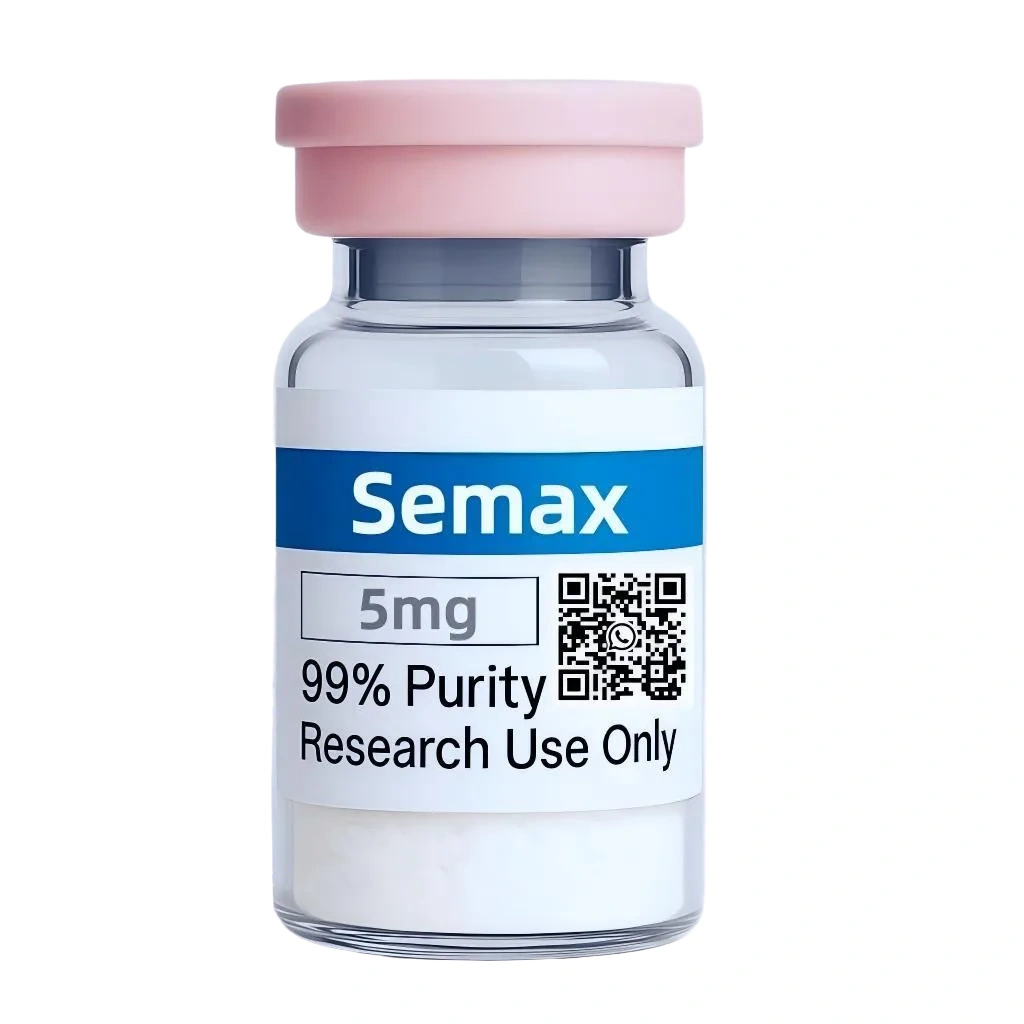
Semax research peptide sourced from verified Chinese manufacturer. HPLC purity verification. Purity tested per batch. Ships internationally.
Semax is a research compound available through our china peptide catalog as a finished, lyophilized vial from an established Chinese manufacturer. It belongs to the Synthetic ACTH(4-7) Analogue / Nootropic Heptapeptide
Available Variants
| Name | Strength | Pack Size | Purity | Availability |
|---|---|---|---|---|
| Semax | 5 mg | 10 vials | ≥98% | In Stock |
| Semax | 5 mg | 10 vials | — | In Stock |
| Semax | 10 mg | 10 vials | — | In Stock |
| Semax | 10 mg | 10 vials | ≥98% | In Stock |
Specification Highlights
Quality & Testing
Testing method: HPLC / LC-MS . Products are supplied against the specification shown on the applicable product page. The standard catalog purity specification is ≥98% unless otherwise stated. Product-specific specifications and quality-control information may vary by compound and batch. Every batch is tested by the manufacturer for purity and concentration as part of routine quality control, using methods such as HPLC and LC-MS. These results are kept in the manufacturer’s internal quality-control records and are not issued as a separate certificate or document.
Research Areas
BDNF & NGF Upregulation in Cognitive Research Semax’s most characterised molecular effect is the induction of BDNF and NGF mRNA and protein in hippocampal, cortical, and striatal tissue. Studies in Wistar and Sprague-Dawley rats document BDNF mRNA increases of 1.4–2.0-fold in hippocampus at 25–100 μg/kg doses (i.p. or intranasal), with protein-level confirmation by ELISA. Behavioural correlates — improved performance in radial arm maze, Morris water maze, and passive avoidance paradigms — are studied alongside BDNF measurements to establish mechanistic linkage. TrkB receptor antagonist (ANA-12) pre-treatment experiments are used to confirm the BDNF-dependence of the cognitive effects. Neuroprotection in Ischaemia Models Semax has been investigated as a neuroprotective agent in rodent cerebral ischaemia models, including transient middle cerebral artery occlusion (MCAO) and global forebrain ischaemia by bilateral carotid artery ligation. Histological endpoints (infarct volume by TTC staining, neuronal survival by NeuN immunohistochemistry) and neurological deficit scoring are used to characterise the neuroprotective window. The proposed mechanisms include anti-excitotoxic effects (reduction of glutamate receptor overactivation), preservation of mitochondrial function in peri-infarct tissue, and anti-inflammatory modulation of microglial activation. Clinical data from Russian stroke trials (Gusev et al.) report improved neurological recovery endpoints, though these studies use non-standard trial designs by current international standards. Dopaminergic & Serotonergic Neurotransmission Microdialysis studies in freely moving rats characterise Semax’s effects on extracellular monoamine concentrations in the striatum and prefrontal cortex. Acute Semax administration is associated with increased dopamine turnover (elevated DOPAC/DA and HVA/DA ratios) and serotonin (5-HT) release in frontal cortical regions. These effects are studied in the context of the compound’s attention-modulating and mood-stabilising activity in behavioural models, and in comparison with conventional stimulants (amphetamine, methylphenidate) to establish a non-stimulant mechanism. Receptor binding assays confirm no direct dopamine or serotonin receptor agonism — the neurotransmitter changes are indirect. Optic Nerve & Visual System Research One registered clinical indication for Semax in Russia is optic nerve disease and glaucoma-associated visual field loss. Preclinical studies in rodent models of optic nerve crush injury (a model of traumatic and glaucomatous axonal injury) and retinal ischaemia characterise Semax’s effects on retinal ganglion cell (RGC) survival, assessed by RBPMS immunolabelling and visual evoked potential (VEP) electrophysiology. NGF upregulation in the retina — demonstrated by Semax administration in these models — is proposed as the neuroprotective mechanism via TrkA receptor signalling on RGCs, which require NGF for survival during stress. ## Sourcing Semax From China
Semax is available through our platform as a china peptide sourced directly from an established Chinese manufacturer. Three points define how we handle it:
- Factory-direct, not trader-sourced. We confirm availability and specification with the manufacturer before the order is confirmed. There is no intermediary resale of unknown-origin vials in this catalog.
- Specification before shipment. The purity and concentration specification shown on this page is the manufacturer’s batch specification. Product-specific quality-control information travels with the order.
- Research-use discipline. Like every listing in our catalog, Semax is supplied for laboratory research use only, under strict research-use terms.
For buyers comparing chinese peptides suppliers, the practical test is whether the seller can name the manufacturer and show the batch documentation. We work the other way around: the manufacturer and the documentation are the offer. Browse the full catalog or see how sourcing works.
Compound Profile
Semax is a synthetic heptapeptide nootropic-neuroprotective compound derived from the 4–7 residue sequence of adrenocorticotropic hormone (ACTH), extended by a C-terminal Pro-Gly-Pro tripeptide. Its full sequence — Met-Glu-His-Phe-Pro-Gly-Pro — represents the melanocortin-active core of ACTH (residues 4–10) without the steroidogenic or adrenocortical activity of the parent hormone, combined with the same stabilising Pro-Gly-Pro extension used in Selank. Semax was developed at the Institute of Molecular Genetics (IMG), Russian Academy of Sciences, by Nikolai Myasoedov’s group and is registered as a pharmaceutical in Russia and Ukraine for cognitive impairment, stroke recovery, and optic nerve disease — providing a rare translational pharmacological dataset for a peptide of this class. The central mechanistic feature of Semax that distinguishes it from parent ACTH fragments is its potent upregulation of brain-derived neurotrophic factor (BDNF) and its receptor TrkB, and nerve growth factor (NGF), in hippocampal and cortical tissue. BDNF induction is documented in rodent models by RT-PCR, immunohistochemistry, and protein ELISA at doses of 25–250 μg/kg. This neurotrophin-upregulating activity, combined with documented effects on dopaminergic and serotonergic transmission in limbic regions, forms the mechanistic basis for Semax’s cognitive-enhancing profile in radial maze, Morris water maze, and passive avoidance learning models. Notably, unlike parent ACTH or other full-length melanocortin peptides, Semax does not elevate corticosterone in rodent stress models at standard doses. Peptides of China supplies research-grade Semax as lyophilized powder at ≥98% purity, verified by HPLC and confirmed by mass spectrometry. Certificates of Analysis per batch. Wholesale quantities on request. For laboratory research use only.
Profile
Available Variants
| Name | Strength | Pack Size | Purity | Availability |
|---|---|---|---|---|
| Semax | 5 mg | 10 vials | ≥98% | In Stock |
| Semax | 5 mg | 10 vials | — | In Stock |
| Semax | 10 mg | 10 vials | — | In Stock |
| Semax | 10 mg | 10 vials | ≥98% | In Stock |
Specification Highlights
Quality & Testing
Testing method: HPLC / LC-MS . Products are supplied against the specification shown on the applicable product page. The standard catalog purity specification is ≥98% unless otherwise stated. Product-specific specifications and quality-control information may vary by compound and batch. Every batch is tested by the manufacturer for purity and concentration as part of routine quality control, using methods such as HPLC and LC-MS. These results are kept in the manufacturer’s internal quality-control records and are not issued as a separate certificate or document.
Research Areas
BDNF & NGF Upregulation in Cognitive Research Semax’s most characterised molecular effect is the induction of BDNF and NGF mRNA and protein in hippocampal, cortical, and striatal tissue. Studies in Wistar and Sprague-Dawley rats document BDNF mRNA increases of 1.4–2.0-fold in hippocampus at 25–100 μg/kg doses (i.p. or intranasal), with protein-level confirmation by ELISA. Behavioural correlates — improved performance in radial arm maze, Morris water maze, and passive avoidance paradigms — are studied alongside BDNF measurements to establish mechanistic linkage. TrkB receptor antagonist (ANA-12) pre-treatment experiments are used to confirm the BDNF-dependence of the cognitive effects. Neuroprotection in Ischaemia Models Semax has been investigated as a neuroprotective agent in rodent cerebral ischaemia models, including transient middle cerebral artery occlusion (MCAO) and global forebrain ischaemia by bilateral carotid artery ligation. Histological endpoints (infarct volume by TTC staining, neuronal survival by NeuN immunohistochemistry) and neurological deficit scoring are used to characterise the neuroprotective window. The proposed mechanisms include anti-excitotoxic effects (reduction of glutamate receptor overactivation), preservation of mitochondrial function in peri-infarct tissue, and anti-inflammatory modulation of microglial activation. Clinical data from Russian stroke trials (Gusev et al.) report improved neurological recovery endpoints, though these studies use non-standard trial designs by current international standards. Dopaminergic & Serotonergic Neurotransmission Microdialysis studies in freely moving rats characterise Semax’s effects on extracellular monoamine concentrations in the striatum and prefrontal cortex. Acute Semax administration is associated with increased dopamine turnover (elevated DOPAC/DA and HVA/DA ratios) and serotonin (5-HT) release in frontal cortical regions. These effects are studied in the context of the compound’s attention-modulating and mood-stabilising activity in behavioural models, and in comparison with conventional stimulants (amphetamine, methylphenidate) to establish a non-stimulant mechanism. Receptor binding assays confirm no direct dopamine or serotonin receptor agonism — the neurotransmitter changes are indirect. Optic Nerve & Visual System Research One registered clinical indication for Semax in Russia is optic nerve disease and glaucoma-associated visual field loss. Preclinical studies in rodent models of optic nerve crush injury (a model of traumatic and glaucomatous axonal injury) and retinal ischaemia characterise Semax’s effects on retinal ganglion cell (RGC) survival, assessed by RBPMS immunolabelling and visual evoked potential (VEP) electrophysiology. NGF upregulation in the retina — demonstrated by Semax administration in these models — is proposed as the neuroprotective mechanism via TrkA receptor signalling on RGCs, which require NGF for survival during stress.