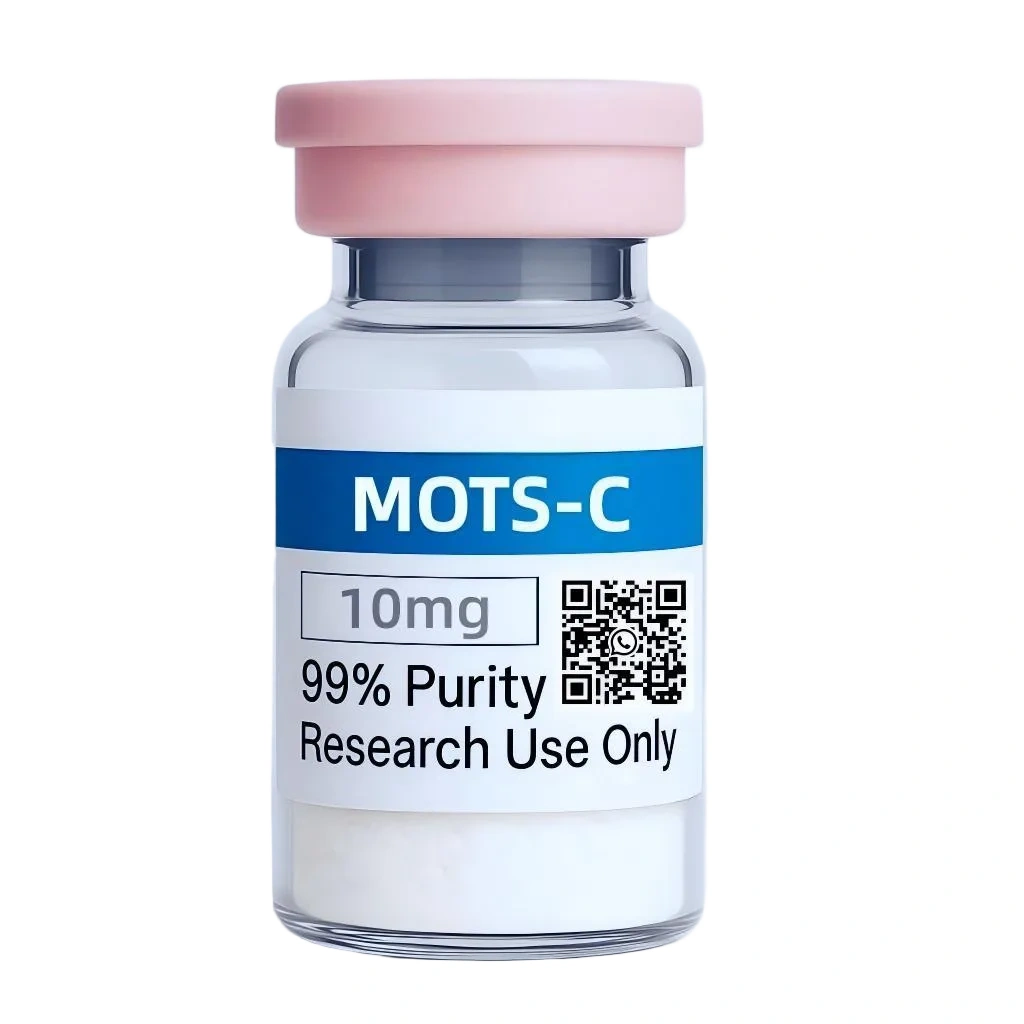
Mitochondria-derived peptide encoded within the 12S rRNA gene. Under investigation in metabolic research for its effects on AMPK signaling pathways, glucose homeostasis, and mitochondrial function.
MOTS-C is a research compound available through our china peptide catalog as a finished, lyophilized vial from an established Chinese manufacturer. It belongs to the Mitochondrial-derived peptide (MDP / Mitokine)
Research Areas
Metabolic regulation, insulin sensitivity, AMPK activation, glucose metabolism, skeletal muscle, aging biology, exercise-mimetic research
Available Variants
| Name | Strength | Pack Size | Purity | Availability |
|---|---|---|---|---|
| MOTS-C | 10 mg | 10 vials | ≥98% | In Stock |
| MOTS-C | 10 mg | 10 vials | — | In Stock |
| 165.00 MOTS-C | 40 mg | 10 vials | — | In Stock |
| MOTS-C | 40 mg | 10 vials | ≥98% | In Stock |
Specification Highlights
Quality & Testing
Testing method: HPLC / LC-MS . Products are supplied against the specification shown on the applicable product page. The standard catalog purity specification is ≥98% unless otherwise stated. Product-specific specifications and quality-control information may vary by compound and batch. Every batch is tested by the manufacturer for purity and concentration as part of routine quality control, using methods such as HPLC and LC-MS. These results are kept in the manufacturer’s internal quality-control records and are not issued as a separate certificate or document.
Research Areas
Metabolic Regulation and Insulin Sensitivity The primary area of MOTS-c research is metabolic disease. In diet-induced obesity mouse models, systemic MOTS-c administration activated AMPK and modulated the folate-methionine cycle, resulting in improved insulin sensitivity, reduced adiposity, and improved glucose metabolism. These findings position MOTS-c as a candidate for further research in type 2 diabetes and metabolic syndrome models. Skeletal Muscle and Exercise-Mimetic Research MOTS-c is naturally elevated in skeletal muscle following exercise in animal models, classifying it as a potential exercise-mimetic mitokine. Exogenous administration has been shown to improve exercise capacity and delay fatigue in rodent models, with proposed mechanisms involving mitochondrial efficiency and metabolite regulation relevant to skeletal muscle energy homeostasis. Aging and Longevity Research Age-related decline in circulating MOTS-c has been documented in both rodent and limited human observational data. Longevity researchers have examined MOTS-c in the context of metabolic homeostasis and healthspan, as its mitochondrial origin connects it directly to mitochondrial decline theories of aging at the molecular level. ## Sourcing MOTS-C From China
MOTS-C is available through our platform as a china peptide sourced directly from an established Chinese manufacturer. Three points define how we handle it:
- Factory-direct, not trader-sourced. We confirm availability and specification with the manufacturer before the order is confirmed. There is no intermediary resale of unknown-origin vials in this catalog.
- Specification before shipment. The purity and concentration specification shown on this page is the manufacturer’s batch specification. Product-specific quality-control information travels with the order.
- Research-use discipline. Like every listing in our catalog, MOTS-C is supplied for laboratory research use only, under strict research-use terms.
For buyers comparing chinese peptides suppliers, the practical test is whether the seller can name the manufacturer and show the batch documentation. We work the other way around: the manufacturer and the documentation are the offer. Browse the full catalog or see how sourcing works.
Available Variants
| Name | Strength | Pack Size | Purity | Availability |
|---|---|---|---|---|
| MOTS-C | 10 mg | 10 vials | ≥98% | In Stock |
| MOTS-C | 10 mg | 10 vials | — | In Stock |
| 165.00 MOTS-C | 40 mg | 10 vials | — | In Stock |
| MOTS-C | 40 mg | 10 vials | ≥98% | In Stock |
Specification Highlights
Quality & Testing
Testing method: HPLC / LC-MS . Products are supplied against the specification shown on the applicable product page. The standard catalog purity specification is ≥98% unless otherwise stated. Product-specific specifications and quality-control information may vary by compound and batch. Every batch is tested by the manufacturer for purity and concentration as part of routine quality control, using methods such as HPLC and LC-MS. These results are kept in the manufacturer’s internal quality-control records and are not issued as a separate certificate or document.
Research Areas
Metabolic Regulation and Insulin Sensitivity The primary area of MOTS-c research is metabolic disease. In diet-induced obesity mouse models, systemic MOTS-c administration activated AMPK and modulated the folate-methionine cycle, resulting in improved insulin sensitivity, reduced adiposity, and improved glucose metabolism. These findings position MOTS-c as a candidate for further research in type 2 diabetes and metabolic syndrome models. Skeletal Muscle and Exercise-Mimetic Research MOTS-c is naturally elevated in skeletal muscle following exercise in animal models, classifying it as a potential exercise-mimetic mitokine. Exogenous administration has been shown to improve exercise capacity and delay fatigue in rodent models, with proposed mechanisms involving mitochondrial efficiency and metabolite regulation relevant to skeletal muscle energy homeostasis. Aging and Longevity Research Age-related decline in circulating MOTS-c has been documented in both rodent and limited human observational data. Longevity researchers have examined MOTS-c in the context of metabolic homeostasis and healthspan, as its mitochondrial origin connects it directly to mitochondrial decline theories of aging at the molecular level.
Compound Profile
MOTS-c (Mitochondrial Open Reading Frame of the 12S rRNA type-c) is a 16-amino acid mitochondrial-derived peptide (MDP) — a class of bioactive peptides encoded by short open reading frames within the mitochondrial genome, termed mitokines. MOTS-c is encoded by the 12S ribosomal RNA gene and was first characterized in 2015 by Lee et al. at the University of Southern California. It is notable for being translated within mitochondria and capable of translocating to the nucleus, acting as a regulator of gene expression and energy metabolism. Preclinical research has focused on MOTS-c in the context of metabolic regulation and glucose homeostasis. Rodent studies have shown that MOTS-c administration activates AMPK, inhibits the folate-methionine cycle, and results in improved insulin sensitivity and reduced adiposity in diet-induced obesity models. Age-related decline of MOTS-c in plasma has been observed in both rodent and human observational data, positioning it within longevity and metabolic aging research as an exercise-mimetic compound. Peptides of China supplies MOTS-c as a lyophilized powder at 5mg concentration, synthesized to 99%+ purity by HPLC and Mass Spectrometry. Every batch is tested by the manufacturer for purity and concentration as part of routine quality control. All products are intended for laboratory research use only and are not for human consumption.
Profile
Research Areas
Metabolic regulation, insulin sensitivity, AMPK activation, glucose metabolism, skeletal muscle, aging biology, exercise-mimetic research
Available Variants
| Name | Strength | Pack Size | Purity | Availability |
|---|---|---|---|---|
| MOTS-C | 10 mg | 10 vials | ≥98% | In Stock |
| MOTS-C | 10 mg | 10 vials | — | In Stock |
| 165.00 MOTS-C | 40 mg | 10 vials | — | In Stock |
| MOTS-C | 40 mg | 10 vials | ≥98% | In Stock |
Specification Highlights
Quality & Testing
Testing method: HPLC / LC-MS . Products are supplied against the specification shown on the applicable product page. The standard catalog purity specification is ≥98% unless otherwise stated. Product-specific specifications and quality-control information may vary by compound and batch. Every batch is tested by the manufacturer for purity and concentration as part of routine quality control, using methods such as HPLC and LC-MS. These results are kept in the manufacturer’s internal quality-control records and are not issued as a separate certificate or document.
Research Areas
Metabolic Regulation and Insulin Sensitivity The primary area of MOTS-c research is metabolic disease. In diet-induced obesity mouse models, systemic MOTS-c administration activated AMPK and modulated the folate-methionine cycle, resulting in improved insulin sensitivity, reduced adiposity, and improved glucose metabolism. These findings position MOTS-c as a candidate for further research in type 2 diabetes and metabolic syndrome models. Skeletal Muscle and Exercise-Mimetic Research MOTS-c is naturally elevated in skeletal muscle following exercise in animal models, classifying it as a potential exercise-mimetic mitokine. Exogenous administration has been shown to improve exercise capacity and delay fatigue in rodent models, with proposed mechanisms involving mitochondrial efficiency and metabolite regulation relevant to skeletal muscle energy homeostasis. Aging and Longevity Research Age-related decline in circulating MOTS-c has been documented in both rodent and limited human observational data. Longevity researchers have examined MOTS-c in the context of metabolic homeostasis and healthspan, as its mitochondrial origin connects it directly to mitochondrial decline theories of aging at the molecular level.