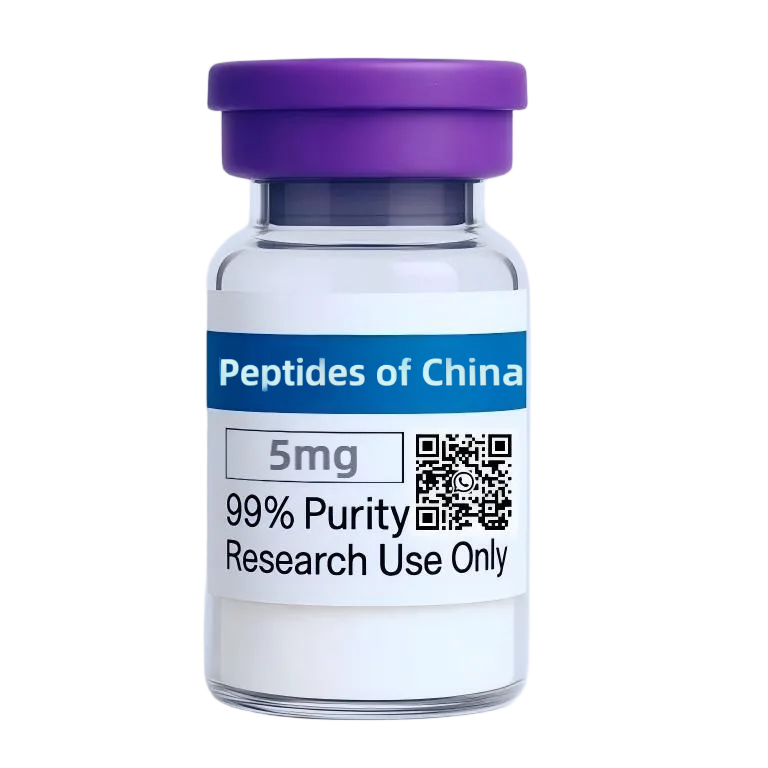
Synthetic peptide corresponding to the active fragment of growth hormone-releasing hormone, GHRH.
Sermorelin Acetate is a research compound available through our china peptide catalog as a finished, lyophilized vial from an established Chinese manufacturer. It belongs to the GHRH Analogue — N-terminal Fragment Also Known As GHRH(1-29), GRF 1-29, Somatocrinin(1-29)
Available Variants
| Name | Strength | Pack Size | Purity | Availability |
|---|---|---|---|---|
| Sermorelin Acetate | 5 mg | 10 vials | — | In Stock |
| Sermorelin Acetate | 5 mg | 10 vials | ≥98% | In Stock |
| Sermorelin Acetate | 10 mg | 10 vials | — | In Stock |
| Sermorelin Acetate | 10 mg | 10 vials | ≥98% | In Stock |
Specification Highlights
Variant Notes
Synthetic analog of endogenous GHRH (1-29). Investigated as a research tool for studying hypothalamic-pituitary GH axis signaling and endogenous GH secretion kinetics.
Research Areas
GH Secretagogue Pharmacology Sermorelin acts at the pituitary GHRHR to stimulate cAMP production and GH release from somatotroph cells. Its 29-residue sequence reproduces the full GHRHR-binding activity of native GHRH(1-44). Primary rat anterior pituitary cell cultures and GHRHR-transfected cell lines are standard in vitro assay formats for characterising sermorelin potency, with cAMP accumulation and GH release (by radioimmunoassay or ELISA) as readouts. In vivo rat and primate studies document dose-dependent GH peak responses with a rapid onset and short duration consistent with its plasma half-life. DPP-IV Kinetics & Analogue Comparison Studies Sermorelin’s high DPP-IV sensitivity — it is cleaved within minutes in plasma — makes it the standard short-acting reference compound in GHRH analogue pharmacokinetic studies. Comparative experiments measuring GH pulse area under the curve (AUC) after equimolar doses of sermorelin versus CJC-1295 Without DAC (Modified GRF 1-29) demonstrate the functional consequence of DPP-IV resistance: larger and more sustained GH peaks with the modified analogue. These studies use DPP-IV activity assays (with synthetic fluorescent substrates) and plasma sermorelin ELISA to quantify in vivo degradation kinetics. Paediatric GH Deficiency Models Sermorelin’s clinical development programme for GH deficiency generated substantial translational data in both rodent models (dwarf rats, hypophysectomised rats) and human clinical trials. In these models, sermorelin administration partially restored linear growth, lean body mass, and IGF-1 levels in GH-deficient animals — providing preclinical benchmarks against which newer GHRH analogues are compared. The compound is used as the reference GHRH agonist in preclinical growth model studies where historical datasets from the clinical programme provide cross-species translation context. Sleep Architecture & GH Pulsatility Endogenous GHRH is a key mediator of the dominant slow-wave sleep (SWS) GH pulse, released from the hypothalamus during the transition into deep sleep. Sermorelin administration in sleep research protocols in rodents and humans augments SWS GH pulses without disrupting sleep architecture, consistent with its physiological role. EEG/polysomnography studies in aged animal models use sermorelin to test whether age-associated decline in nocturnal GH pulses can be restored by exogenous GHRHR stimulation — a model relevant to the biology of somatopause. ## Sourcing Sermorelin Acetate From China
Sermorelin Acetate is available through our platform as a china peptide sourced directly from an established Chinese manufacturer. Three points define how we handle it:
- Factory-direct, not trader-sourced. We confirm availability and specification with the manufacturer before the order is confirmed. There is no intermediary resale of unknown-origin vials in this catalog.
- Specification before shipment. The purity and concentration specification shown on this page is the manufacturer’s batch specification. Product-specific quality-control information travels with the order.
- Research-use discipline. Like every listing in our catalog, Sermorelin Acetate is supplied for laboratory research use only, under strict research-use terms.
For buyers comparing chinese peptides suppliers, the practical test is whether the seller can name the manufacturer and show the batch documentation. We work the other way around: the manufacturer and the documentation are the offer. Browse the full catalog or see how sourcing works.
Compound Profile
Sermorelin is a synthetic 29-amino acid peptide corresponding to the biologically active N-terminal fragment of endogenous human growth hormone-releasing hormone (GHRH), specifically GHRH(1–29). The full-length native GHRH is 44 amino acids, but the first 29 residues contain the complete receptor-binding domain required for GHRH receptor (GHRHR) activation — a finding established by systematic truncation studies in pituitary cell models. Sermorelin was the first synthetic GHRH analogue to complete clinical development for paediatric GH deficiency — later withdrawn for commercial rather than safety reasons — providing a body of human pharmacokinetic and pharmacodynamic data uncommon for research peptides. The key pharmacokinetic limitation of sermorelin relative to its structural successors is its short plasma half-life of approximately 10–12 minutes, attributable to rapid cleavage at the His²-Ala³ bond by dipeptidyl aminopeptidase IV (DPP-IV). This sensitivity makes it a useful negative pharmacological control in DPP-IV inhibition studies, and underlies the development of the four-substitution analogue CJC-1295 Without DAC (Modified GRF 1-29), which confers DPP-IV resistance while retaining the same receptor pharmacology. In research comparing GHRH analogue half-life and GH pulse kinetics, sermorelin serves as the short-acting reference compound. Peptides of China supplies sermorelin as the acetate salt in lyophilized form at ≥98% purity, verified by HPLC and confirmed by mass spectrometry. Certificates of Analysis per batch. Wholesale quantities available on request. For laboratory research use only.
Profile
Available Variants
| Name | Strength | Pack Size | Purity | Availability |
|---|---|---|---|---|
| Sermorelin Acetate | 5 mg | 10 vials | — | In Stock |
| Sermorelin Acetate | 5 mg | 10 vials | ≥98% | In Stock |
| Sermorelin Acetate | 10 mg | 10 vials | — | In Stock |
| Sermorelin Acetate | 10 mg | 10 vials | ≥98% | In Stock |
Specification Highlights
Variant Notes
Synthetic analog of endogenous GHRH (1-29). Investigated as a research tool for studying hypothalamic-pituitary GH axis signaling and endogenous GH secretion kinetics.
Research Areas
GH Secretagogue Pharmacology Sermorelin acts at the pituitary GHRHR to stimulate cAMP production and GH release from somatotroph cells. Its 29-residue sequence reproduces the full GHRHR-binding activity of native GHRH(1-44). Primary rat anterior pituitary cell cultures and GHRHR-transfected cell lines are standard in vitro assay formats for characterising sermorelin potency, with cAMP accumulation and GH release (by radioimmunoassay or ELISA) as readouts. In vivo rat and primate studies document dose-dependent GH peak responses with a rapid onset and short duration consistent with its plasma half-life. DPP-IV Kinetics & Analogue Comparison Studies Sermorelin’s high DPP-IV sensitivity — it is cleaved within minutes in plasma — makes it the standard short-acting reference compound in GHRH analogue pharmacokinetic studies. Comparative experiments measuring GH pulse area under the curve (AUC) after equimolar doses of sermorelin versus CJC-1295 Without DAC (Modified GRF 1-29) demonstrate the functional consequence of DPP-IV resistance: larger and more sustained GH peaks with the modified analogue. These studies use DPP-IV activity assays (with synthetic fluorescent substrates) and plasma sermorelin ELISA to quantify in vivo degradation kinetics. Paediatric GH Deficiency Models Sermorelin’s clinical development programme for GH deficiency generated substantial translational data in both rodent models (dwarf rats, hypophysectomised rats) and human clinical trials. In these models, sermorelin administration partially restored linear growth, lean body mass, and IGF-1 levels in GH-deficient animals — providing preclinical benchmarks against which newer GHRH analogues are compared. The compound is used as the reference GHRH agonist in preclinical growth model studies where historical datasets from the clinical programme provide cross-species translation context. Sleep Architecture & GH Pulsatility Endogenous GHRH is a key mediator of the dominant slow-wave sleep (SWS) GH pulse, released from the hypothalamus during the transition into deep sleep. Sermorelin administration in sleep research protocols in rodents and humans augments SWS GH pulses without disrupting sleep architecture, consistent with its physiological role. EEG/polysomnography studies in aged animal models use sermorelin to test whether age-associated decline in nocturnal GH pulses can be restored by exogenous GHRHR stimulation — a model relevant to the biology of somatopause.