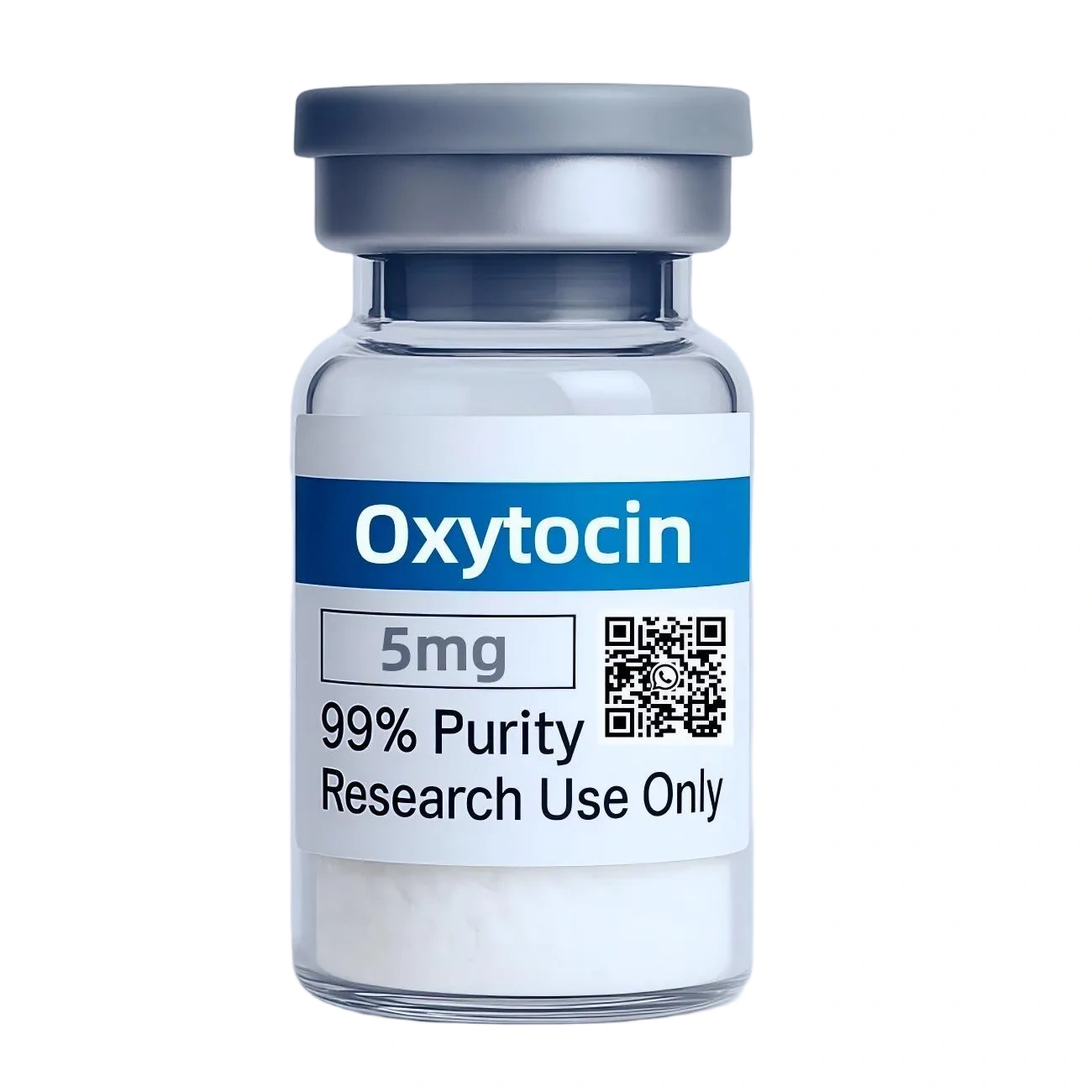
Synthetic nonapeptide identical to endogenous oxytocin.
Oxytocin Acetate is a research compound available through our china peptide catalog as a finished, lyophilized vial from an established Chinese manufacturer. It belongs to the Cyclic nonapeptide neurohormone (acetate salt)
Research Areas
Social behavior neuroscience, anxiety/fear research, maternal behavior, metabolic regulation, uterine pharmacology
Available Variants
| Name | Strength | Pack Size | Purity | Availability |
|---|---|---|---|---|
| Oxytocin Acetate | 5 mg | 10 vials | ≥98% | In Stock |
| Oxytocin Acetate | 10 mg | 10 vials | ≥98% | In Stock |
Specification Highlights
Quality & Testing
Testing method: HPLC / LC-MS ([“HPLC”,“LC-MS”,“Endotoxins”,“Water Content”,“Assay”]) . Products are supplied against the specification shown on the applicable product page. The standard catalog purity specification is ≥98% unless otherwise stated. Product-specific specifications and quality-control information may vary by compound and batch. Available documentation: .
**Where provided, these documents reflect the manufacturer’s batch testing for this compound.
Research Areas
Social Behavior and Neuroscience Research Rodent research has established oxytocin as a key modulator of pro-social behavior via OXTR signaling in the amygdala, nucleus accumbens, and prefrontal cortex. Studies have examined oxytocin’s effects on social recognition memory, partner preference, separation anxiety, and aggression in both conventional and social defeat models. Oxytocin serves as the reference compound for studies investigating the neurochemical basis of social bonding and its disruption in psychiatric disease models. Fear, Anxiety, and Amygdala Research Research has examined oxytocin’s anxiolytic properties — particularly its suppression of amygdala fear responses via OXTR-mediated inhibition of CeA (central amygdala) neurons. Fear extinction paradigms using intra-amygdala oxytocin infusion in rodents have contributed to understanding of how oxytocin modulates fear memory consolidation and extinction. These studies position oxytocin as a pharmacological tool in anxiety and PTSD model research. Metabolic and Peripheral Receptor Research Beyond CNS effects, oxytocin receptor expression in adipose tissue, pancreatic β-cells, and adrenal glands has generated research interest in peripheral oxytocin signaling. Rodent studies have examined oxytocin’s apparent effects on food intake, fat mass, and glucose metabolism — a phenotype consistent with OXTR expression in hypothalamic energy-sensing circuits. The peripheral metabolic effects of oxytocin represent an emerging area of research distinct from its classical reproductive and social neuroscience roles. ## Sourcing Oxytocin Acetate From China
Oxytocin Acetate is available through our platform as a china peptide sourced directly from an established Chinese manufacturer. Three points define how we handle it:
- Factory-direct, not trader-sourced. We confirm availability and specification with the manufacturer before the order is confirmed. There is no intermediary resale of unknown-origin vials in this catalog.
- Specification before shipment. The purity and concentration specification shown on this page is the manufacturer’s batch specification. Product-specific quality-control information travels with the order.
- Research-use discipline. Like every listing in our catalog, Oxytocin Acetate is supplied for laboratory research use only, under strict research-use terms.
For buyers comparing chinese peptides suppliers, the practical test is whether the seller can name the manufacturer and show the batch documentation. We work the other way around: the manufacturer and the documentation are the offer. Browse the full catalog or see how sourcing works.
Available Variants
| Name | Strength | Pack Size | Purity | Availability |
|---|---|---|---|---|
| Oxytocin Acetate | 5 mg | 10 vials | ≥98% | In Stock |
| Oxytocin Acetate | 10 mg | 10 vials | ≥98% | In Stock |
Specification Highlights
Quality & Testing
Testing method: HPLC / LC-MS ([“HPLC”,“LC-MS”,“Endotoxins”,“Water Content”,“Assay”]) . Products are supplied against the specification shown on the applicable product page. The standard catalog purity specification is ≥98% unless otherwise stated. Product-specific specifications and quality-control information may vary by compound and batch. Available documentation: .
**Where provided, these documents reflect the manufacturer’s batch testing for this compound.
Research Areas
Social Behavior and Neuroscience Research Rodent research has established oxytocin as a key modulator of pro-social behavior via OXTR signaling in the amygdala, nucleus accumbens, and prefrontal cortex. Studies have examined oxytocin’s effects on social recognition memory, partner preference, separation anxiety, and aggression in both conventional and social defeat models. Oxytocin serves as the reference compound for studies investigating the neurochemical basis of social bonding and its disruption in psychiatric disease models. Fear, Anxiety, and Amygdala Research Research has examined oxytocin’s anxiolytic properties — particularly its suppression of amygdala fear responses via OXTR-mediated inhibition of CeA (central amygdala) neurons. Fear extinction paradigms using intra-amygdala oxytocin infusion in rodents have contributed to understanding of how oxytocin modulates fear memory consolidation and extinction. These studies position oxytocin as a pharmacological tool in anxiety and PTSD model research. Metabolic and Peripheral Receptor Research Beyond CNS effects, oxytocin receptor expression in adipose tissue, pancreatic β-cells, and adrenal glands has generated research interest in peripheral oxytocin signaling. Rodent studies have examined oxytocin’s apparent effects on food intake, fat mass, and glucose metabolism — a phenotype consistent with OXTR expression in hypothalamic energy-sensing circuits. The peripheral metabolic effects of oxytocin represent an emerging area of research distinct from its classical reproductive and social neuroscience roles.
Compound Profile
Oxytocin is a cyclic nonapeptide neurohormone synthesized in the hypothalamus (paraventricular and supraoptic nuclei) and released from the posterior pituitary. Its structure — a six-residue disulfide-bonded ring (Cys¹-Cys⁶) with a three-residue C-terminal tail — is shared with the vasopressin/oxytocin peptide family. Oxytocin acetate is the acetic acid salt form used for research, providing enhanced aqueous stability compared to the free base. Research interest encompasses oxytocin’s roles in social behavior, pair bonding, maternal behavior, anxiety modulation, and peripheral effects including uterine contractility and lactation. CNS oxytocin research has expanded substantially beyond its classical roles in parturition and lactation. Studies in rodent models have examined oxytocin’s effects on social recognition memory, fear extinction, aggression reduction, and reward circuitry modulation — primarily via the oxytocin receptor (OXTR) expressed in amygdala, hippocampus, nucleus accumbens, and prefrontal cortex. Research in autism spectrum disorder (ASD) models has used oxytocin as a pharmacological probe for studying social deficit phenotypes. Peripheral oxytocin research includes its role in metabolic regulation — OXTR is expressed in adipose tissue, and rodent studies have examined oxytocin’s apparent role in energy homeostasis. Peptides of China supplies oxytocin acetate as a lyophilized powder at 99%+ purity, verified by HPLC and Mass Spectrometry. Every batch is tested by the manufacturer for purity and concentration as part of routine quality control. All products are for laboratory research use only and are not for human consumption.
Profile
Research Areas
Social behavior neuroscience, anxiety/fear research, maternal behavior, metabolic regulation, uterine pharmacology
Available Variants
| Name | Strength | Pack Size | Purity | Availability |
|---|---|---|---|---|
| Oxytocin Acetate | 5 mg | 10 vials | ≥98% | In Stock |
| Oxytocin Acetate | 10 mg | 10 vials | ≥98% | In Stock |
Specification Highlights
Quality & Testing
Testing method: HPLC / LC-MS ([“HPLC”,“LC-MS”,“Endotoxins”,“Water Content”,“Assay”]) . Products are supplied against the specification shown on the applicable product page. The standard catalog purity specification is ≥98% unless otherwise stated. Product-specific specifications and quality-control information may vary by compound and batch. Available documentation: .
**Where provided, these documents reflect the manufacturer’s batch testing for this compound.
Research Areas
Social Behavior and Neuroscience Research Rodent research has established oxytocin as a key modulator of pro-social behavior via OXTR signaling in the amygdala, nucleus accumbens, and prefrontal cortex. Studies have examined oxytocin’s effects on social recognition memory, partner preference, separation anxiety, and aggression in both conventional and social defeat models. Oxytocin serves as the reference compound for studies investigating the neurochemical basis of social bonding and its disruption in psychiatric disease models. Fear, Anxiety, and Amygdala Research Research has examined oxytocin’s anxiolytic properties — particularly its suppression of amygdala fear responses via OXTR-mediated inhibition of CeA (central amygdala) neurons. Fear extinction paradigms using intra-amygdala oxytocin infusion in rodents have contributed to understanding of how oxytocin modulates fear memory consolidation and extinction. These studies position oxytocin as a pharmacological tool in anxiety and PTSD model research. Metabolic and Peripheral Receptor Research Beyond CNS effects, oxytocin receptor expression in adipose tissue, pancreatic β-cells, and adrenal glands has generated research interest in peripheral oxytocin signaling. Rodent studies have examined oxytocin’s apparent effects on food intake, fat mass, and glucose metabolism — a phenotype consistent with OXTR expression in hypothalamic energy-sensing circuits. The peripheral metabolic effects of oxytocin represent an emerging area of research distinct from its classical reproductive and social neuroscience roles.